
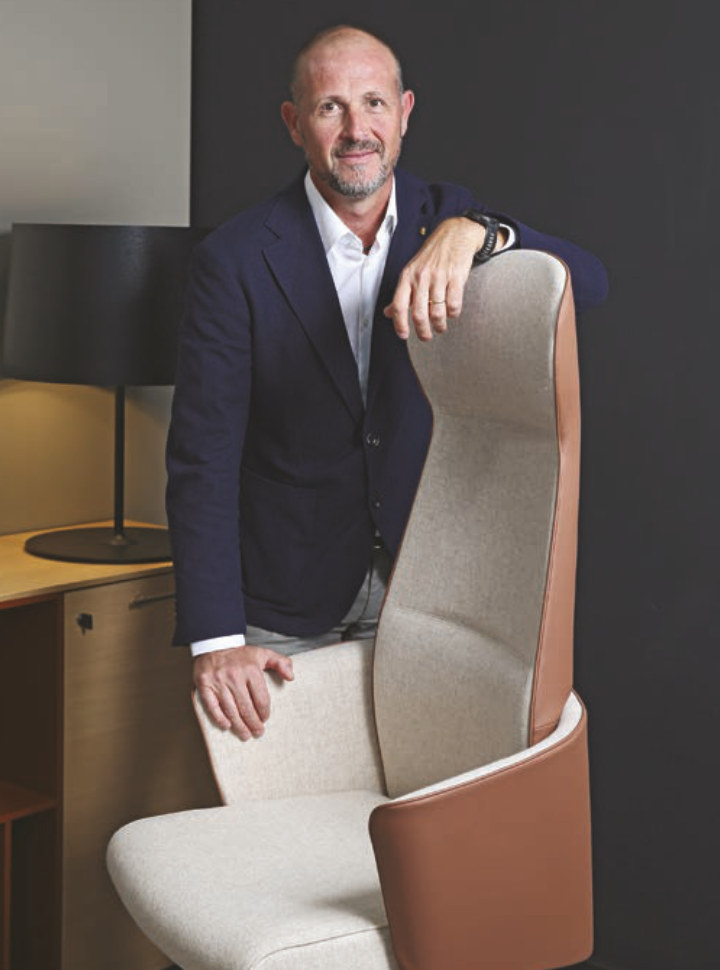
From the furniture-making district of Treviso to Bralco’s new Milan showroom, CEO Alex Bressan reflects on more than thirty years of the company’s evolution and the decisions shaping its response to changing ways of working.
Founded in the furniture-making district of Treviso, Bralco has spent more than thirty years developing an approach to the office as a whole, bringing to it the care and sense of wellbeing we associate with home. At its helm is Alex Bressan, whose curiosity extends beyond furniture, combining manufacturing expertise, material research and a fresh perspective on the workplace. We explore the decisions that have brought Bralco to this point and the outlook guiding its future.
Bralco’s roots lie in an understanding of materials and how to work with them. Today, it designs its own collections and supports office projects from design through to delivery. Over more than thirty years, what shifted the focus from individual products to the space as a whole?
Working with the people who design those spaces. Our knowledge of manufacturing gave us a solid foundation, because we understood what could be made and how. Developing our own collections required new skills and investment in research. As we worked more closely with designers, specifiers and commercial partners, we came to understand that a piece of furniture finds its purpose in the space it becomes part of. That understanding led us to develop consultancy, customisation and support services, everything needed to ensure that a desk or chair reaches the right place and performs as expected. The practical approach we started with still shapes our thinking.
Your region brings together an entire furniture supply chain, with materials, specialist skills and manufacturing processes developed over many years. What difference does having that network nearby make to office designers?
It changes the quality of the conversation. When a designer brings an idea, they find people here who know how to give it form. The discussion centres on what can be achieved and the best way to achieve it. Our in-house research works in dialogue with an industrial community accustomed to turning designs into objects, and that daily exchange broadens the possibilities. We take this with us into international markets too. The region’s manufacturing culture is a recognisable part of what we offer.
From production to delivery, how do you reconcile the flexibility each project requires with meeting deadlines?
We bring together two approaches, keeping products in stock and managing just-in-time production. CNC machinery and flexible equipment allow us to carry out specific manufacturing tasks, while coordination between these two approaches enables us to offer a wide variety of solutions with short lead times. Alongside our collections, we offer the option to adapt them to the needs of different environments. Research, the technical department and production are in constant dialogue, allowing industrial efficiency to accommodate the finishes and details, including handcrafted elements, that give furniture its identity.
You work with wood, metal, leather and textiles. Where does the choice of a material begin?
We ask what a material can bring to a product, considering its performance, how it can be worked and its aesthetic qualities. In the office, quality is measured through everyday experience, through contact with a surface, the comfort of a chair or the way a finish stands up to use over time. In-house research and our exchanges with designers help us offer long-lasting products that can become part of very different projects.
Sustainability also contributes to wellbeing. How do you incorporate it into design?
Through our choice of materials and the life of the furniture. We seek raw materials with a low environmental impact, consider the health of indoor environments and develop products designed to last. We also think about what happens when requirements change. Furniture that is easy to disassemble can be reconfigured, reused or recycled. Packaging follows the same principle, using materials that can be separated and recycled. This work encompasses both design and company processes, with attention to resource consumption and waste management.
Bralco aims to bring the care we give our homes into the office. In practical terms, how does this change the way we choose furniture for work?
It changes the question we begin with. At home, we choose a sofa or table partly for how it makes us feel, for its comfort, appealing materials and colours we connect with. I believe the same perspective belongs in the office, where a day moves between concentration, conversation, meetings and breaks, each requiring different conditions. That is why we work on a broad range of solutions, from height-adjustable desks and seating designed for shared spaces to acoustic elements. The aim is to help people feel comfortable throughout the activities of their day, in thoughtfully designed, welcoming and collaborative environments.
Hybrid workspaces are constantly changing. How does a new introduction such as this year’s My Belle Sofa System respond to that transformation?
It begins with the idea that a shared space evolves with the people who use it. Designed by Studio Baldanzi & Novelli, My Belle Sofa System is modular. It can be planned, extended and reconfigured. Seats and backrests connect easily, allowing the arrangement to follow the rhythm of work and the people around it. The same area can move from lounge to meeting space, from waiting area to collaborative setting, as patterns of use and functions change. In today’s office, it offers a practical response to spaces in transition. We want the people designing them to be able to rely on furniture that supports that process.
In March 2026, you opened a showroom on Via Maroncelli in Milan. Why did you choose that location?
The location is part of the project. The Maroncelli District brings together galleries, ateliers, studios and cultural venues. We wanted to engage with that community and be close to people developing projects every day. It is an approach we also recognise in London’s Clerkenwell district. We manage the showroom directly, welcoming professionals, partners and the public into an environment that expresses our vision.
What did you want the showroom design to convey?
That it is possible to create different working environments while maintaining a coherent design language. The project was developed by our R&D team in collaboration with SP4CE Studio, under the creative direction of architect Stefano Verga. Visitors move through executive offices, operational work areas and spaces for interaction. The materials library offers an opportunity to explore finishes, fabrics and combinations, while the two meeting rooms allow visitors to experience different configurations.
Which markets and relationships do you see growing over the coming years?
Europe remains central, particularly France, the United Kingdom, the Netherlands, Spain and Germany. We maintain our presence through trade fairs and direct dialogue with partners, because each market has its own sensibilities. An international offering needs both a clear identity and a willingness to listen. Our sales network is an important part of that dialogue. Those working locally know their customers and provide valuable insights that help us develop our offering. We provide technical and commercial support, along with tools for creating layouts and visualisations of spaces. We work alongside partners from design through to delivery and after-sales support.
And within the company?
The third generation is joining the business, an important step that will bring new perspectives. My role is to create the conditions for those perspectives to develop, while continuing to build on the expertise Bralco has accumulated.